condiment product development
Condiment Product Development: Keeping Pesto Green and Chutney Pieces Intact
At a glance
- Client: UK sauce and condiment producers (anonymised, drawn from several projects)
- Products: a range of chunky pestos for roasting with root vegetables and squash, plus chutney and relish development
- Challenge: browning and dulling of green pieces, and moving a chilled range towards ambient
- Process: hot fill and in-pack pasteurisation, matched to each product
- TasteBond's role: new product development, formulation, process design and food safety
Summary
Pesto and chutney look simple on the shelf. Making them look freshly made after processing is not. This case study draws on several condiment product development projects with UK sauce producers: a range of chunky pestos built for roasting, chilled first with a route to ambient, alongside new chutneys and relishes. The core problem was the same each time. Heat and acid make a product safe, and both destroy green colour.
The challenge: a fresh appearance in a processed product
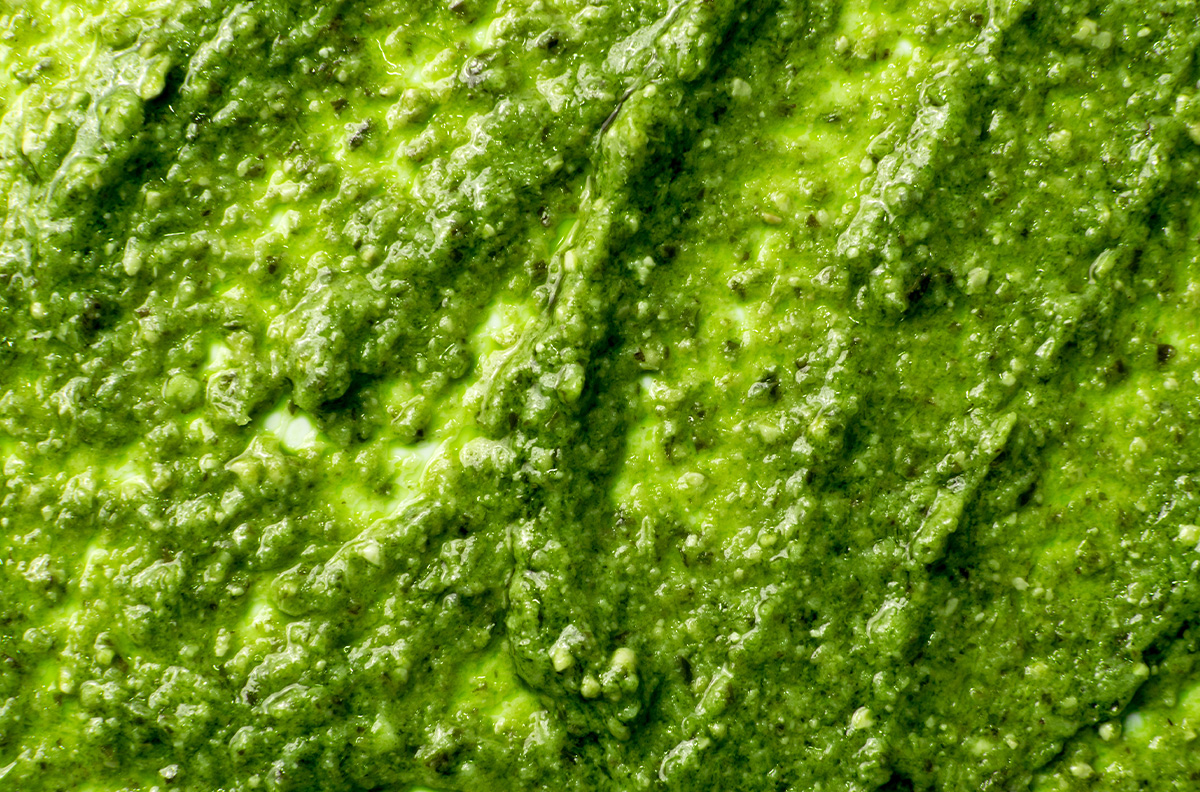
Pesto sells on colour. A bright green sauce reads as fresh. An olive-brown one reads as old, whatever the date code says.
The brief went beyond basil, pine nuts and hard cheese. These were pesto chunks: thicker, coarser pestos with visible pieces, designed to be tossed through root vegetables and squash before roasting. That raised three problems.
Chlorophyll does not like processing
Green herbs owe their colour to chlorophyll. Heat and acid strip the magnesium out of the chlorophyll molecule and turn it into pheophytin, which is olive-brown. Enzymes released when leaves are cut push in the same direction, and oxygen in the jar finishes the job. Every step that extends shelf life works against the colour.
Pieces have to survive
A smooth pesto can hide some colour loss. A chunky one cannot. Pieces dull, soften or bleed into the oil during cooking and filling, and once they break down the product looks like any other sauce.
Chilled now, ambient next
The range started chilled, with the shelf life and distribution limits that come with it. Ambient opens up more retailers and cuts waste, but it means lower pH, more heat, or both. Garlic and herbs held under oil are also a classic Clostridium botulinum risk if acidity is not controlled, so the food safety case had to be built alongside the recipe, not after it.
Our approach to pesto product development
Colour, texture and safety were treated as one problem. Fixing safety first and then trying to rescue the colour is where most pesto projects go wrong.
Protecting colour at every stage
- Ingredient choice: selecting herbs and greens with more stable colour, and building flavour from ingredients that tolerate heat and acid.
- Blanching: a short blanch to knock out the enzymes behind browning, followed by fast chilling to stop the cook.
- Time at temperature: cutting how long the product sits hot, from cooking through filling to cooling.
- Oxygen: using the oil phase and controlled headspace to limit oxidation in the jar.
- Acid timing: adding acid as late in the cook as the safety case allows.
Pushing flavour beyond basil
Pesto is a format, not a fixed recipe: a herb or green, a fat, a nut or seed, a hard cheese, salt and acid. Treated that way, every element can be swapped. Development explored different herbs and greens, alternative nuts and seeds, and different cheeses, with each version judged on how it tasted after roasting rather than straight from the jar. A pesto going into a hot oven needs a different balance of oil, salt and acid to one spooned over pasta.
Matching the process to the product
There is no single right process for this category. Each product was assessed on pH, water activity, particle size and target shelf life, then matched to hot fill or in-pack pasteurisation.
Hot fill relies on filling at temperature, typically 85°C or above, holding long enough to treat the jar and lid, then cooling fast. It suits acidic, pourable products. Chunky products need more care. Heat takes longer to reach the centre of a piece than the sauce around it, so the slowest-heating point sits inside the largest piece. Process times have to be set around that point, not the liquid.
For chilled pesto under oil, FSA guidance on non-proteolytic C. botulinum applies. Reduced-oxygen chilled foods are limited to 10 days unless a recognised controlling factor is in place, such as a pH of 5.0 or below.
Chutney and relish development: same problem, different rules
The same principles carried into chutney and relish work, where the question is less about colour and more about where the product sits in its category.
- Chutney: cooked long and slow until fruit and vegetables break down into a soft, dark, jammy texture. Vinegar, sugar and spice preserve it, and the flavour develops over weeks in the jar.
- Relish: cooked for less time, keeps distinct pieces with some bite, and tastes sharper and fresher.
- Jam: fruit and sugar set with pectin, with little or no vinegar.
Those definitions drive development decisions. Cut size, cook time and when the vinegar and sugar go in decide whether pieces hold their shape. Vegetables soften more slowly in acidic, sugary conditions, so adding the vinegar and sugar earlier keeps more bite. A producer who wants a relish but cooks it like a chutney ends up with neither.
What was delivered
- Formulations for a range of chunky pestos built for roasting
- Process steps for each product, covering blanching, cook, fill temperature, hold and cooling
- A colour retention approach that kept green pieces green through processing
- Chutney and relish formulations placed clearly in their category
- A defined route from chilled to ambient, setting out the pH, process and safety controls required
The results
- Chunky pestos with visible green pieces after processing, rather than a product that reads as standard sauce
- A flavour range that moved well beyond basil while staying recognisably pesto
- A clear picture of what ambient requires, so the producer could weigh the cost of reformulation and process change against the commercial gain before committing
- Chutneys and relishes with textures that match what the label says they are
Pesto and chutney development FAQs
What is the difference between chutney, jam and relish?
Chutney is fruit or vegetables cooked slowly with vinegar, sugar and spices until soft and dark. Relish is cooked for less time, so it stays chunkier, brighter and sharper. Jam is fruit cooked with sugar and set with pectin, usually without vinegar. Jam relies on sugar, chutney relies on vinegar and a long cook, and relish relies on a short cook and distinct pieces.
Why does pesto turn brown?
Heat and acid convert green chlorophyll into olive-brown pheophytin. Enzymes released when herbs are cut, and exposure to oxygen, add to the effect. A short blanch, less time at temperature and keeping oxygen out of the jar all slow it down.
Can fresh pesto be made shelf-stable?
Yes. Ambient pesto relies on a combination of acidity, water activity and heat treatment. The pH has to sit below 4.6 to control Clostridium botulinum, which matters in any product with garlic and herbs held in oil. The trade-off is colour, because more acid and more heat both speed up browning.
Is hot fill or pasteurisation better for sauces?
Hot fill suits acidic, smooth or pourable products that can be filled at temperature. In-pack pasteurisation gives more control over chunky products, where heat needs time to reach the centre of each piece. The right choice depends on pH, particle size, pack format and target shelf life.
About TasteBond
TasteBond is a UK food and drink consultancy based in the Cotswolds, run by Connor Bond. Connor's background runs from Michelin-level kitchens to food manufacturing and thermal processing at Campden BRI. TasteBond covers new product development, thermal process validation, shelf-life work and HACCP for food and drink brands and manufacturers across the UK.
Developing a sauce, pesto or chutney?
Whether you are building a new condiment range or trying to take a chilled product ambient, book a discovery call to talk through your product, your process and what it will take to get it on shelf.
Email us at: connor.bond@tastebond.co.uk
Or use our quick enquiry form here. We look forward to hearing from you!