plant-based product development
Plant-Based Product Development: A Vegan Scotch Egg With a Runny Yolk
Summary
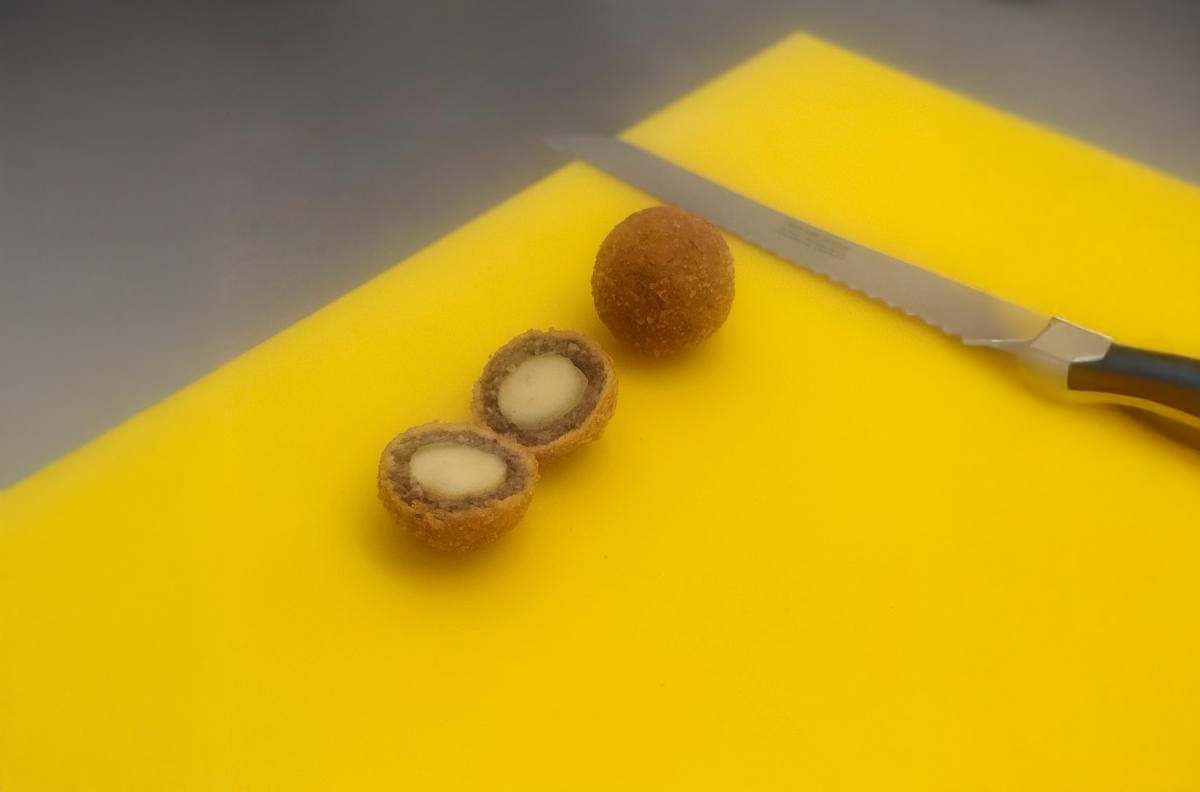
High-protein and plant-based are two of the fastest-growing categories in UK food, and the products that win are the ones that match meat on taste and texture rather than asking shoppers to compromise. TasteBond set an in-house brief through plant-based product development to build a high-protein vegan snack that could hold its own next to a meat version, and reinvented the classic Scotch egg. The result is baked rather than fried, built entirely from plant proteins, and holds a yolk that sets firm to shape and runs when warm. The concept took first place at an innovation competition.
The challenge
A vegan Scotch egg has three hard problems in one product.
There is no egg. There is no meat. And the single feature people love most about a Scotch egg, the soft yolk, is the hardest thing to recreate without one. A yolk has to look right, sit at the centre, hold its shape while the snack is built and cooked, then soften and flow when it is eaten. Plant gels tend to do one of those jobs, not both.
On top of that, the outer layer had to carry real flavour and real protein, not read as a filler. The brief called for a snack that stood up in a high-protein category where the bar for taste is set by meat, and that could be baked rather than fried to support a cleaner, higher-protein position.
The approach: plant-based product development in two phases
Phase one: proving the format
The first iteration was a high-protein meat snack that swapped the egg for a caramelised apple core, using the classic pork and apple pairing. That version proved the format and the flavour logic before the switch to plant-based, so the vegan build started from a concept that already worked.
Phase two: engineering a yolk that runs
The yolk is the centre of the product in every sense. TasteBond built it from a carrot and coriander purée for colour and flavour, set with agar agar, a thermo-reversible plant gel. Set at the right level, it holds shape while the snack is built and baked, then runs when the finished product is cut warm.
Phase three: building the egg and the coating
The set yolk was dipped in aquafaba, the liquid chickpea extract that whips and binds like egg white, to form an egg-white-style layer around it and complete the egg centre. Aquafaba proteins set on heating, so the same ingredient also worked as the adhesion layer for the coating.
That egg centre was wrapped in shredded textured soya and wheat protein, a duck-style plant protein carrying a soy-led oriental flavour, then coated in panko breadcrumbs and finished with chia and sesame seeds. The seeds added texture, a lift in protein, and a nod to the oriental flavour direction. The whole thing was baked, not fried.
What was delivered
A complete, competition-ready plant-based snack concept, worked up from first idea to a build that can be made and repeated:
- A full formulation and construction method for a vegan, high-protein Scotch egg
- A working set-yolk system using agar agar that runs at serving temperature
- Aquafaba used as both an egg-white analogue and a binding coat
- A layered flavour profile: carrot and coriander yolk, soy-led duck-style outer, seeded crust
- A baked format that supports a high-protein, cleaner-label position
The results
The concept hit the brief: a snack that is fully plant-based, high in protein, and baked rather than fried, with a yolk that behaves like a yolk. It was entered into an innovation competition and took first place, and it targets one of the fastest-growing snack categories in the UK.
FAQ
How do you get a runny yolk in a vegan Scotch egg?
Set the yolk with a plant gel such as agar agar. At the right level it holds shape while the snack is built and cooked, then softens and runs at eating temperature. Colour and flavour come from the purée base, in this case carrot and coriander.
What can replace egg in plant-based product development?
It depends on the job the egg is doing. For binding, foaming and an egg-white role, aquafaba (liquid chickpea extract) works well and sets on heating. For structure and a set centre, plant gels such as agar do the work. Matching the replacer to the function is the core of good plant-based development.
Can TasteBond develop a high-protein plant-based product for my brand?
Yes. TasteBond takes plant-based and high-protein products from first concept through recipe trials to a build that is ready to scale, covering formulation, flavour, texture and food safety along the way.
About TasteBond
TasteBond is a UK food and drink consultancy based in the Cotswolds, run by Connor Bond. Connor's background runs from Michelin-level kitchens to food manufacturing and thermal processing at Campden BRI. TasteBond covers new product development, thermal process validation, shelf-life work and HACCP for food and drink brands and manufacturers across the UK.
Book a discovery call
If you are developing a plant-based or high-protein product and want it to match meat on taste and texture, book a discovery call with TasteBond and we will talk through how to get it made.
Email us at: connor.bond@tastebond.co.uk
Or use our quick enquiry form here. We look forward to hearing from you!