thermal process validation
Thermal Process Validation for UK Food Manufacturers: The Right Method for Every Oven, Retort and Tunnel
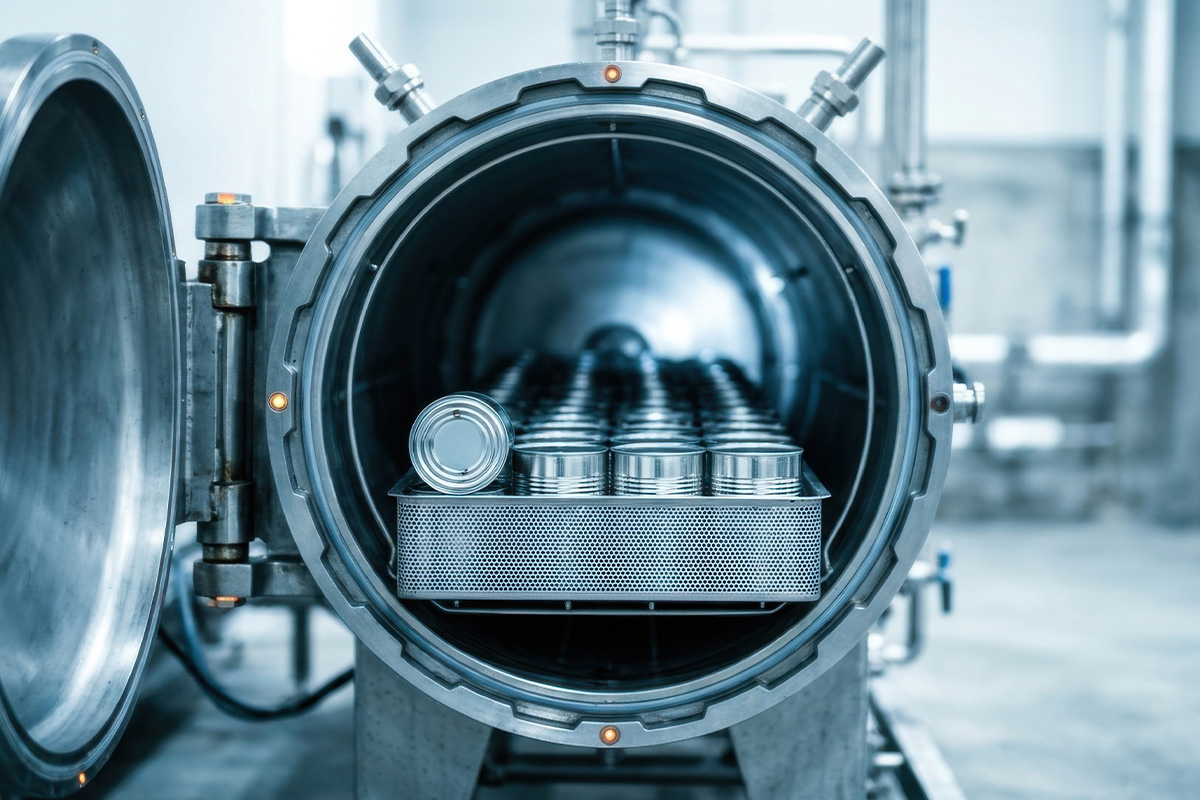
Thermal process validation goes wrong most often before a single probe goes in. A manufacturer applies the method they know to a process it doesn't suit: thermocouples in a microwave field, a rigid probe in a product 4 mm thick, a retort-style study on a travelling oven. The data looks fine. It just doesn't prove what it needs to prove. TasteBond has validated thermal processes for UK food and drink manufacturers across static, travelling and rotational ovens, four retort types, RF and microwave tunnels, batch cooking and hot fill, and picks the measurement method to fit the heating mechanism, the product and the pack.
The challenge: one goal, very different thermal processes
Every thermal process exists for the same reason: deliver a defined heat treatment to the slowest-heating part of every pack, every time. How you prove that changes completely with the equipment.
A saturated steam retort and a water spray retort heat a load in different ways and have different cold spots. A rotational oven moves product through hot and cooler zones. An RF tunnel heats from within the product, and any metal sensor in the field distorts the heating or fails outright. A hot-filled beverage relies on the product's own heat to treat the container and closure. A thin sheet product leaves no room for a probe at all.
Treat these as the same job and you end up with a process validation that passes on paper and misses the real cold spot. That's a food safety risk, an audit finding waiting to happen, and often an over-processed product as well, because the safety margin was set by guesswork.
Our approach to thermal process validation
Start with the process, not the kit
Each study begins with a survey of the equipment and process: the heating medium, how it reaches the product, load patterns, control and recording systems, and the critical factors in the product and pack. That survey decides the method. The method never decides the survey.
Retort validation: temperature distribution, then heat penetration
Retort validation follows the IFTPS sequence, across saturated steam (vertical), steam air, raining water and water spray systems.
- Temperature distribution comes first. Probes mapped through a fully ballasted load confirm the retort reaches temperature evenly. The IFTPS benchmark is that all measuring points sit within 0.5°C of the minimum process temperature at the end of come-up, and reach it within a minute of the hold starting.
- Heat transfer distribution comes next for systems where the medium reaches packs unevenly, such as water spray and steam air. Comparing heating rate (fh) values across the load shows whether heat transfer is uniform. Where variation is above the IFTPS threshold of 5%, the slowest-heating positions are pinned down and used for everything that follows.
- The heat penetration study then measures the product's own cold spot, at worst-case fill weight, solids content and initial temperature, in the slowest location in the retort. That's the data the F0 and the scheduled process rest on, and the data any future process deviation is judged against.
Oven validation and temperature mapping: static, travelling and rotational
Ovens get the same two-part logic: temperature mapping through the oven, then heat penetration in the product. For travelling and rotational ovens, the product moves through the heat, so trailing wires are not an option. Wireless data loggers in thermal barriers travel with the product and record the core temperature through the full cycle, including the coolest point of the belt or rack.
RF and microwave process validation
Conventional thermocouples do not belong in an electromagnetic field. Validation here uses protected data loggers where they can be used without distorting heating, alongside enzyme-based time temperature integrators (TTIs). TTIs record the heat treatment delivered as a measurable change in enzyme activity, with no wires or metal, so they can sit in the parts of a product that are hardest to reach and most likely to underheat.
Batch cooking and hot fill validation
Batch cooking systems are profiled to prove the whole batch reaches and holds the target, not just the point nearest the probe. Hot fill validation covers products and beverages, checking fill temperature, the cold point in the container, and whether the closure and headspace actually receive the treatment the process depends on.
Thermal imaging for thin and hard-to-probe products
Where a probe can't be placed reliably, for example thin products, surfaces or sheet goods, thermal imaging maps surface temperature across the product and finds the cold zones a single probe would miss.
Interpreting the data: lethality, F0 and P values
Collecting temperatures is the easy part. The value is in reading them properly: confirming the cold spot is the real cold spot, checking that probes held position, accounting for come-up, and calculating lethality (F0 or P value) against the target. The answer has to be clear: does this process consistently deliver the required treatment, and under what conditions does it stay valid?
What TasteBond delivers
- A validation method chosen for the equipment, heating mechanism, product and pack
- Temperature distribution, heat transfer distribution and heat penetration studies to IFTPS methodology, where they apply
- Measurement matched to the job: wired or wireless probes, protected loggers, TTIs or thermal imaging
- Lethality calculations against the process target, with the critical factors and limits defined
- A thermal process validation report fit for HACCP, UK retailer and third-party audits, and future process deviation reviews
The results of getting thermal process validation right
- Processes proven safe at the true cold spot, not an assumed one
- Validation that holds up to UK retailer and third-party audit scrutiny
- Critical limits set on data, giving production a defined operating window
- Over-processing identified and removed where the margin allowed, protecting texture, colour and flavour
- Equipment covered across convection, conduction, RF, microwave and hot fill processes
FAQ
What is thermal process validation?
It's the documented proof that a cooking, pasteurising or sterilising process consistently delivers the required heat treatment to the slowest-heating part of the product. It usually combines temperature mapping of the equipment with heat penetration data from the product.
What is the difference between a temperature distribution study and a heat penetration study?
A temperature distribution study maps the heating environment, the retort or oven, to find its coldest zone. A heat penetration study measures how fast the product itself heats at its cold spot. You need both to set a safe process.
How do you validate a microwave or RF heating process?
Standard thermocouples interfere with the electromagnetic field, so validation uses protected data loggers where suitable and enzyme-based time temperature integrators, which record the heat treatment without wires or metal.
How often does a thermal process need revalidating?
Whenever the product, pack, equipment or process changes, and on a periodic basis, often annually, as part of a verification programme.
About TasteBond
TasteBond is a UK food and drink consultancy based in the Cotswolds, run by Connor Bond. Connor's background runs from Michelin-level kitchens to food manufacturing and thermal processing at Campden BRI. TasteBond covers new product development, thermal process validation, shelf-life work and HACCP for food and drink brands and manufacturers across the UK.
Book a discovery call
Commissioning a new oven, retort or tunnel, changing a product, or facing an audit with thin validation data? Book a discovery call with TasteBond and we'll talk through the right thermal process validation approach for your process.
Email us at: connor.bond@tastebond.co.uk
Or use our quick enquiry form here. We look forward to hearing from you!